
Introduction to Latin American Civilization II
Course Code
LACS 16200 10
Cross Listed Course Code(s)
ANTH 23102, HIST 16102, RDIN 16200, SOSC 26200
Course Description
This course sequence introduces students to the history and cultures of Latin America, an area of the world that includes Mesoamerica (Mexico and Central America), South America, and the Caribbean.
This section addresses the evolution of colonial societies, the wars of independence, and the emergence of Latin American nation-states in the changing international context of the nineteenth century.
Course Criteria
Taking these courses in chronological sequence is not required. This sequence meets the general education requirement in civilization studies and is open to first-year students.
This course is primarily comprised of undergraduate students. A select number of places are reserved for advanced high school students.
The cost of this course for pre-college students is $4,980
Instructor(s)
Mauricio Tenorio
Start Your ApplicationOther Courses to Consider
These courses might also be of interest.
- Introduction to Latin American Civilization III
This sequence introduces students to the history and cultures of Latin America, an area of the world that includes Mesoamerica (Mexico and Central America), South America, and the Caribbean. It focuses on the long twentieth century (1870+), with emphasis on how Latin American peoples and nations have grappled with the challenges of development, inequality, imperialism, revolution, authoritarianism, racial difference, migration, urbanization, citizenship, violence, and the environment.
Remote  Plants, Pathogens, and People
Students will explore the major plant disease causing pathogens and how scientists and farmers are working to protect our food supply. You will explore the biology of the major groups of disease-causing microorganisms (bacteria, fungi, oomycetes, viruses, and nematodes).
We will learn how plants are protected from infection - including protection from plant immunity, genetic improvement, and disease management practices. Additionally, we will discuss how plant pathogens have and continue to shape society - from the Irish Potato Famine to modern day disease epidemics.
Emphasis will be placed on understanding scientific research in the context of plant biology - from experimental design to data analysis. Students will apply their knowledge and critical thinking skills through case studies and analysis of new research findings. This course will encourage students to use their strengths and interests to explore plant pathology and will allow flexibility to explore student questions and curiosities.
Residential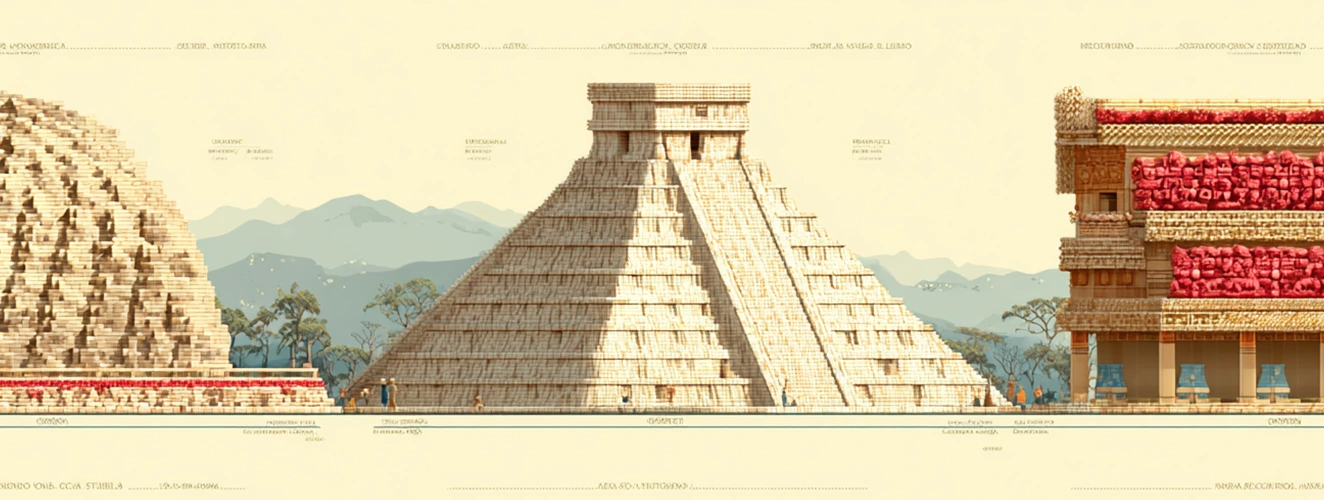 Mesoamerican Architecture
This course will examine the range of architectural expression in Mexico, Guatemala, Honduras, and Belize from 1500 BCE to 1600 CE.
Using a relatively simple vocabulary of elements (house, pyramid, plaza, ballcourt, and road), each Mesoamerican city constructed a distinctive visual identity, exquisitely attuned to the surrounding environment. Moving city by city over time, we will look closely at individual buildings as well as the spatial relationships between structures.
At the end of the course, students will have honed their ability to analyze architectural space and its representations, and to write cogently about what they see.
Remote